Key takeaways
- Panicle and smooth hydrangeas flower on wood they grow this year, so they are pruned in early spring. Bigleaf and oakleaf hydrangeas flower on last year's wood. The University of Minnesota Extension says bigleaf sets next year's buds in August and September, so prune it after it blooms and before August.
- Lilacs flower on old wood and next year's buds start forming in summer, so the window is the few weeks after the flowers fade. Wisconsin Horticulture puts it at within about two weeks after blooming.
- Royal Botanical Gardens' Katie Osborne Lilac Collection peaked anywhere from the week of May 13 to the week of May 31 over ten years: an 18-day spread, with a median of the week of May 22. Prune off your own shrub, not the calendar.
- "Early spring" is not one date here: Environment and Climate Change Canada's 1991–2020 normals give an average last spring frost of Apr 11 downtown, Apr 27 at Pearson and May 03 at Buttonville, and frost-free periods of 208, 174 and 161 days.
- A big multi-stem lilac can be a tree under Toronto's by-law: § 813-12 protects a multi-stem tree with at least one stem 30 centimetres or more measured at 1.4 metres above ground. Pruning in accordance with good arboricultural practice is exempt under § 813-13 B; taking it out is not.
Before you pick a date, ask one thing about the plant. Does it make its flower buds on wood it grew last year, or on wood it will grow this year? Old wood plants set next year's buds soon after they bloom: lilacs, bigleaf and oakleaf hydrangeas, once-blooming roses, ramblers. Prune those in the few weeks after the flowers fade. New wood plants build buds on fresh growth each spring: panicle and smooth hydrangeas, hybrid teas, floribundas, most modern shrub roses. Prune those in early spring, before growth starts. Get them backwards and you lose a season of flowers.
Old wood or new wood
UMass Extension puts old-wood flowering plainly: "flower buds develop on the stems during the summer the year before they bloom". Wisconsin Horticulture adds a number for spring bloomers, which "form their flower buds the previous year". Prune those "within about two weeks after blooming".
Plant | Flowers on | When to prune here | Source |
|---|---|---|---|
Panicle hydrangea (H. paniculata) | New wood | Late winter or spring | UMN Extension |
Smooth hydrangea (H. arborescens) | New wood | Spring, once established | UMN Extension |
Bigleaf hydrangea (H. macrophylla) | Old wood; rebloomers, both | After bloom, before August | UMN Extension |
Oakleaf hydrangea (H. quercifolia) | Old wood | Right after flowering, late summer | Toronto MG |
Lilac (Syringa) | Old wood | Within two weeks of the flowers fading | Wisconsin Hort |
Hybrid tea, floribunda, grandiflora | New wood | Early spring as buds swell | Toronto MG |
Once-blooming and species roses | Old wood | After the blooms fade | Iowa State |
"Hydrangea" is not one instruction
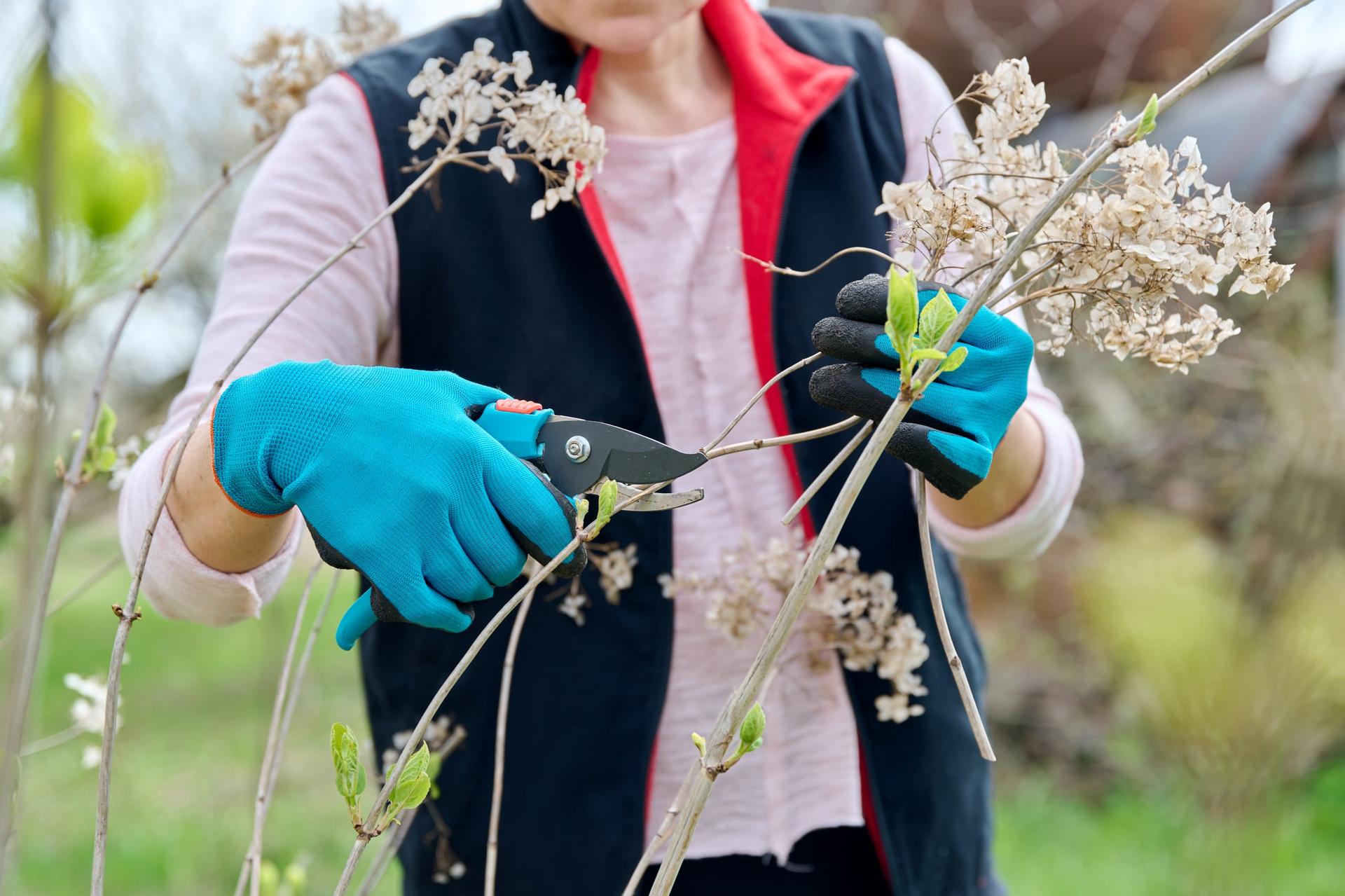
Panicle hydrangea flowers on this year's growth. Minnesota Extension cuts stems back to just above a fat bud "in fall, late winter or spring". It prefers late winter or spring, so the dry flower heads carry the winter. The RHS goes harder: prune last year's growth back to the lowest pair of healthy buds. That leaves a framework "no more than 25cm (10in) high", or about 60cm (2ft) for more height.
Smooth hydrangea ('Annabelle' and relatives) also flowers on this year's growth. Minnesota lets a new plant grow a season or two, then prunes it in spring down to the ground. For a bigger shrub, leave it alone.
Bigleaf hydrangea is the one people cut at the wrong time. Minnesota Extension says these "produce buds in late summer to early fall (August-September) that will form next year's flowers. So prune these shrubs after they finish blooming before August". The rebloomers are the exception (Endless Summer and its siblings). They flower "on last year's wood and new wood that grows this year", so they bloom whether you prune or not. Even then, UMass warns that "the majority of blooms occur on old wood".
Oakleaf hydrangea flowers on the previous year's growth. Toronto Master Gardeners cite the Missouri Botanical Garden. Prune right after flowering in late summer. Leave as much old wood with buds on the stem tips as you can. Early in the season, cut only dead or broken branches.
Deadheading is not pruning
Deadheading is snapping off the spent flower, nothing else. The RHS leaves faded mophead blooms on over winter, because they "help protect the new tender growth below from frost damage". It cuts back in mid-spring, only to the first or second strong healthy pair of buds below the dead flower. Minnesota's "before August" rule is about a heading cut, which shortens whole stems. Only the second costs you flowers.
Lilacs: the window opens when the flowers fade
Lilacs flower on old wood, and the window is tight. Oregon State Extension explains why: "next year's buds begin forming in summer. Pruning in winter removes those buds and eliminates the following spring's blooms".
The Missouri Botanical Garden puts most lilacs in its minimal-pruning group. Take out dead and diseased wood, crossing branches, suckers and watersprouts (the whippy shoots from base and old limbs). Go no further, because "these shrubs can be damaged by excessive pruning". For a lilac gone thin and leggy, Oregon State renews it slowly. Cut about one-third of the old canes to the ground in the first spring, right after flowering. Take the rest out in stages over two years. On a grafted plant, never cut below the graft union, the swollen joint low on the stem.
When that actually happens in the GTA
Royal Botanical Gardens publishes peak-bloom week for its Katie Osborne Lilac Collection at its Hamilton Arboretum.
Year | Peak bloom | Year | Peak bloom |
|---|---|---|---|
2025 | Week of May 16 | 2020 | Week of May 31 |
2024 | Week of May 13 | 2019 | Week of May 23 |
2023 | Week of May 17 | 2018 | Week of May 27 |
2022 | Week of May 22 | 2017 | Week of May 14 |
2021 | Week of May 23 | 2016 | Week of May 22 |
In order (May 13, 14, 16, 17, 22, 22, 23, 23, 27, 31), the middle two are both May 22, so the median is the week of May 22. Earliest and latest sit 18 days apart (May 31 minus May 13). Six of the ten peaked in the week of May 22 or later. RBG's own note: "bloom dates can vary drastically from year to year".
Roses: the class on the label sets the date
Toronto Master Gardeners give the local rule. Roses are pruned "in early spring at the end of the dormant season. In Toronto this is usually in April or May, just before new growth begins and as the buds begin to swell. Wait until the danger of a hard frost is past or newly pruned tips may be killed".
Landscape Ontario gives you a sign: when forsythia is in bloom, your roses should show swelling buds but no leaves. That is the moment to cut out dead stems and twiggy growth. Keep three or four strong canes at most, and cut them to about 15 cm, within 6 mm of an outward-facing bud. Then the class of rose decides.
- Hybrid teas, floribundas and grandifloras take the hardest cut. Iowa State Extension cuts dead wood out once winter protection comes off (late March to mid-April in Iowa). It goes at least 1 inch below the brown areas of a cane. After a mild winter with only minor damage, it cuts back to within 8 to 12 inches of the ground. Toronto Master Gardeners' garden-display version is gentler: each stem back about a third.
- Shrub and landscape roses get a light hand. Iowa State says they "typically bloom continuously on new wood from early summer to frost", so prune just as buds break. Toronto Master Gardeners come at it from the other side. Laterals are the side shoots off a main cane. This group, including the Explorer series and the David Austin roses, "flower best on short laterals produced each season on the older wood". So they "are usually pruned only lightly in early spring".
- Once-blooming old garden and species roses cover rugosas, gallicas, damasks, and the native meadow, Carolina and prairie roses. They "bloom once in late spring, so prune any wayward or overgrown canes after blooms fade". Remove unwanted suckers after new growth finishes, early to mid-summer.
- Climbers, in the same guide, get only basic upkeep pruning in early spring. Once the flowers fade in summer, cut the laterals that carried them back to within two or three buds of the main canes. Iowa State adds a warning: some climbing roses bloom on new wood and others on old, so identify yours first.
- Ramblers, in that same guide, grow canes that "do not flower until their second year of growth". Prune soon after they flower. Take out one old cane at ground level per new one.
No rose wants a fall haircut. Iowa State says not to prune in the fall: pruning pushes out soft new growth that cannot harden off before winter. Stop deadheading hybrid teas, grandifloras and floribundas in late August or September.
"Early spring" is not one date here
Advice written elsewhere misfires here: Southern Ontario's spring is not one spring. Here are three GTA stations in Environment and Climate Change Canada's 1991–2020 normals.
Station | Average last spring frost | Average first fall frost | Frost-free period | 25% chance the last spring frost falls on or after |
|---|---|---|---|---|
Toronto (City), downtown | Apr 11 | Nov 06 | 208 days | May 07 |
Toronto Pearson, Mississauga | Apr 27 | Oct 20 | 174 days | May 13 |
Toronto Buttonville, Markham | May 03 | Oct 13 | 161 days | May 11 |
Downtown and Buttonville sit three weeks apart on the average last spring frost, and 47 days apart on the frost-free period (208 − 161). That is why "the danger of a hard frost is past" beats a fixed date.
Two rules that can stop you cutting
Your lilac might be a tree
Toronto's tree by-law does not care what you call the plant. By-law 402-2026 rewrote § 813-12 of Municipal Code Chapter 813 from September 1, 2026. It bans injuring, destroying or removing "any tree, including a multi-stem tree" without a permit. The test is whether "at least one stem has a diameter measurement of 30 centimeters or more". Trees planted because of a planning approval, compliance action or tree permit are protected at any size. The chapter measures "1.4 metres above ground level for each stem of a double stem or multi-stemmed tree", so one thick stem is enough. A sixty-year-old lilac can clear that bar.
Routine pruning is not the problem. § 813-13 B exempts "Pruning of a tree in accordance with good arboricultural practice". The chapter ties that phrase to "the American National Standards, ANSI 300" and ISA best management practices, "to the satisfaction of the Executive Director". Taking the shrub out is different. The application fee now sits in Chapter 441, Appendix C, Schedule 20 (§ 813-14A(2)).
Toronto is mid-change. The City's Tree Bylaw Review page records amendments effective September 1, 2026, among them a Distinctive Tree Category. It covers healthy private trees over 61 cm in diameter at breast height. Council has endorsed dropping the protected size "from 30 cm to 20 cm" only in principle, pending analysis and a report in 2027. That is not the rule today. Thresholds differ across the region too.
- **Mississauga** protects private trees 15 cm (6 inches) or greater in diameter, dead or dying ones included. The base permit fee is $399.77 (HST included) and non-refundable. Each extra healthy tree 15 cm or greater, or any public tree, is $139.72 (HST included). Dead or dying trees carry no fee at all.
- **Brampton** says you need no permit to remove a tree "located within 2 metres (6 feet 6 inches) of an occupied building". The same goes for one "with a diameter of less than 30 centimetres (12 inches) measured at 1.37 metres height from the ground". That is the City's own summary of its Tree Preservation By-law. Read the by-law before you rely on an exemption.
The birds get there first
The lilac window and nesting season are the same window. Under the federal Migratory Birds Regulations, 2022, s. 5, a person must not "damage, destroy, remove or disturb a nest". An exception at 5(2)(b) covers a nest built by a species not listed in a Table to Schedule 1, and only "if that nest does not contain a live bird or a viable egg". Ontario's Fish and Wildlife Conservation Act, 1997 covers the rest. Section 7(1) says "A person shall not destroy, take or possess the nest or eggs of a bird that belongs to a species that is wild by nature". Section 7(2) excepts the American crow, brown-headed cowbird, common grackle, house sparrow, red-winged blackbird and starling. Section 7(4) hands migratory birds back to the federal Act. The export read carries the consolidation period "From March 30, 2026".
ECCC publishes general nesting periods by zone. Zone C1 runs late March to late August. It reaches north from Lake Erie "to the south of the Cities of London and Toronto". Zone C2 covers the Lower Great Lakes plain north of that, early April to late August. The GTA sits on the boundary. ECCC advises that "when working near the boundary of a zone, you should also consider the nesting period of the adjacent zone". Its zone C2 calendars predict 61 to 100 percent of species studied actively nesting from May 20 to July 21 in open habitats. In forest habitats, May 22 to July 21. A garden is neither, but the overlap is the point.
Look before you cut, in June especially
The right week to prune a lilac here is also the peak of nesting season. Check the shrub for a nest in use before you start, and wait if you find one. ECCC's periods are planning guidance, not permission. The federal ban applies to any nest holding a live bird or a viable egg, on any date.
Frequently asked questions
Can I cut my hydrangea back in the fall?
Only a panicle or smooth hydrangea. Minnesota Extension lists fall for panicle but prefers late winter or spring. Cutting a bigleaf or oakleaf in fall removes the buds it set in August and September, and next summer's flowers with them.
My bigleaf hydrangea has not bloomed in years. Am I pruning it wrong?
Maybe, but check the winter first. UMass Extension names three bud killers: low temperatures, swings in temperature, and late frost or freeze events. It rates the species "cold hardy to Zone 6" and says plants "need to be protected when grown in Zone 5". Even in the right spot, it warns, "there will be years that a Hydrangea macrophylla will not bloom because of unfavorable winter (or spring) conditions". Its fix: a cylinder of burlap or chicken wire and stakes, filled with leaves or straw. Those zone numbers do not map onto a Canadian plant tag. The 2025 update to Canada's hardiness maps reports "no simple way to convert between the Canadian and US systems".
When do I take the winter protection off my roses?
Landscape Ontario says as soon as the ground thaws. Take the evergreen boughs or rose collars off. Later, remove the soil mounded around the canes and rough-prune winter-killed tips back to live wood.
Sources (24)
- Pruning hydrangeas · University of Minnesota Extension (retrieved )
- How to grow shrubby hydrangeas · Royal Horticultural Society (retrieved )
- Oakleaf hydrangeas didn't bloom, how and when to prune · Toronto Master Gardeners (retrieved )
- Why Hydrangea macrophylla Don't Flower · UMass Extension Landscape, Nursery and Urban Forestry Program (retrieved )
- Gardening Help FAQs: How do I prune my flowering shrubs? · Missouri Botanical Garden (retrieved )
- Keep lilacs healthy and blooming with regular pruning · Oregon State University Extension Service (retrieved )
- Proper Timing Key When Pruning · Wisconsin Horticulture, UW-Madison Division of Extension (retrieved )
- Lilacs: the Katie Osborne Lilac Collection · Royal Botanical Gardens (retrieved )
- How to Prune Roses · Iowa State University Extension and Outreach (retrieved )
- Pruning Roses: A Toronto Master Gardeners Guide · Toronto Master Gardeners (retrieved )
- Roses: type and pruning · Landscape Ontario Horticultural Trades Association (retrieved )
- Canadian Climate Normals 1991–2020: Toronto (City), climate ID 6158355 · Environment and Climate Change Canada (retrieved )
- Canadian Climate Normals 1991–2020: Toronto Pearson (Airport), climate ID 6158733 · Environment and Climate Change Canada (retrieved )
- Canadian Climate Normals 1991–2020: Toronto Buttonville (Airport), climate ID 6158409 · Environment and Climate Change Canada (retrieved )
- General nesting periods of migratory birds: Nesting periods · Environment and Climate Change Canada (retrieved )
- Migratory Birds Regulations, 2022 (SOR/2022-105) · Department of Justice Canada (retrieved )
- Fish and Wildlife Conservation Act, 1997, S.O. 1997, c. 41 · King's Printer for Ontario (retrieved )
- Toronto Municipal Code Chapter 813, Trees (consolidated May 12, 2022) · City of Toronto (retrieved )
- City of Toronto By-law 402-2026 (amends Chapters 813, 658 and 441; in force September 1, 2026) · City of Toronto (retrieved )
- Toronto Municipal Code Chapter 441, Fees and Charges (consolidated May 22, 2025) · City of Toronto (retrieved )
- Tree Bylaw Review · City of Toronto (retrieved )
- Tree permits · City of Mississauga (retrieved )
- Tree Regulations and Plans · City of Brampton (retrieved )
- Updated plant hardiness zones for Canada and assessment of change over time (Sci Rep 15, 22774) · Scientific Reports (retrieved )
How this guide was made
Checked on August 26, 2026 against Environment and Climate Change Canada's 1991–2020 climate normals for three GTA stations and its general nesting periods for migratory birds, the Migratory Birds Regulations, 2022, Ontario's Fish and Wildlife Conservation Act, 1997, Toronto Municipal Code Chapter 813 and the City's Tree Bylaw Review page, the Mississauga and Brampton tree-permit pages, the Royal Botanical Gardens' ten-year lilac bloom record, and horticultural guidance from the Toronto Master Gardeners, Landscape Ontario, the Missouri Botanical Garden, the RHS and the Minnesota, Massachusetts, Iowa, Wisconsin and Oregon extension services. Updated September 29, 2026 for Toronto By-law 402-2026 (in force September 1, 2026), read in full from the enacted PDF.