Key takeaways
- In the National Research Council's 2026 sun table, Toronto's night (sunset to sunrise) first runs past 12 hours on September 26, past 13 on October 16 and past 14 only on November 7. Counting only full dark after twilight, 12 hours comes October 15 and 14 never does. Extension sources ask for 12 to 16 hours of darkness, depending on the source and how warm the room is.
- Cool nights can set buds without long nights. Clemson Extension says nights of 50 to 59 °F (10 to 15 °C) do it regardless of day length, though buds may drop at 50 °F, and the average September night at the four GTA weather stations runs 10.4 to 13.8 °C.
- October's average night falls to 4.3 to 7.7 °C at those stations, below Clemson Extension's 50 °F (10 °C) line for bringing the plant in, so the GTA deadline is late September at the latest, and the third week of September in Mississauga or Markham.
- Iowa State Extension says most plants sold as Christmas cactus are Thanksgiving cacti or hybrids, and Thanksgiving cacti bloom mid-November to late December. Canadian Thanksgiving is October 12, 2026, 45 days before the US holiday on November 26.
- Of 12 GTA sellers checked on September 28, seven show a price: $4.98 for a 4-inch (in stock at one of four GTA stores checked) and $10.98 for a 6-inch pot (sold out at all four) at Home Depot once you pick a GTA store, $12 to $16.99 at four plant shops (all sold out), $59.99 at a Markham florist and $47.00 to $89.00 by pot size at a Burlington florist.
A Christmas cactus flowers after weeks of long nights, cool nights, or both. In Toronto the sky starts to help on September 26, when the night (sunset to sunrise) first runs past 12 hours in the National Research Council's 2026 sun table. It doesn't pass 14 hours until November 7. So leave the plant outside in light shade until late September downtown, or the third week of September in Mississauga or Markham. Bring it in before nights fall to about 10 °C, and put it in a cool room where no lamp goes on after dark. Don't move it once buds show. If yours flowers in November, it's probably a Thanksgiving cactus, which is what most plants sold as Christmas cactus turn out to be.
Christmas, Thanksgiving or Easter: check the stem segments
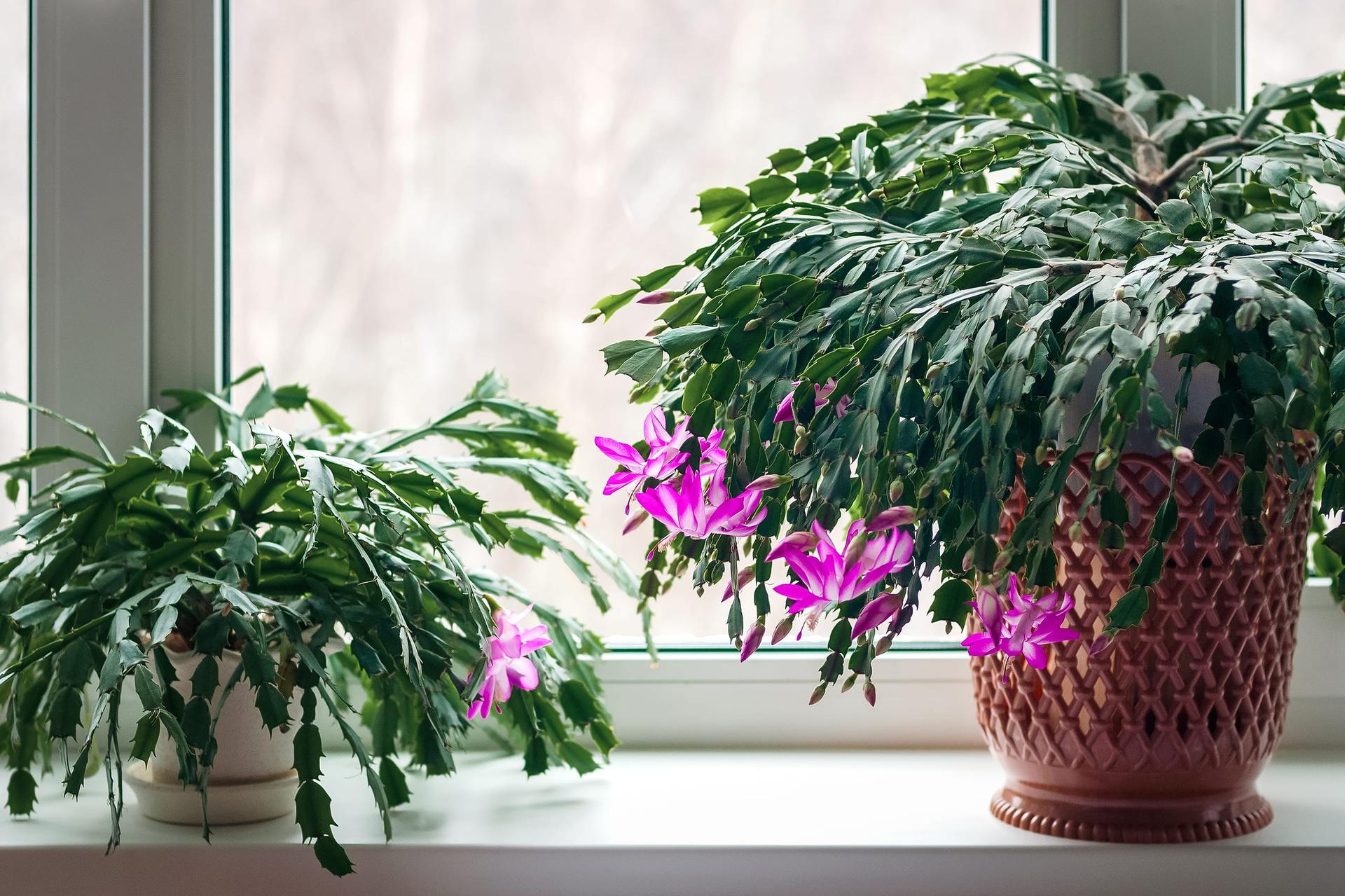
Three plants share the name holiday cactus, and yours may not be a Christmas cactus at all. Iowa State University Extension says so plainly: "Most plants sold as 'Christmas cactus' are actually Thanksgiving cactus or hybrids."
The flat green "leaves" are really stem segments. Their edges tell you which plant you have.
| Plant | Stem segment edges | Flowers | Usual bloom time |
|---|---|---|---|
| Thanksgiving cactus (Schlumbergera truncata) | 2 to 4 pointed teeth that point upward, like claws | Tube-shaped, yellow anthers (the pollen tips) | Mid-November to late December |
| Christmas cactus (Schlumbergera x buckleyi) | Scalloped and rounded, no teeth | Tube-shaped, purplish-brown anthers | Late November to early February |
| Easter cactus (Schlumbergera gaertneri) | Smoother, 4 to 6 slight ripples, brownish bristles at the tips | Star-shaped | March to May |
Illinois Extension says holiday cacti "get their common names from the holiday closest to their traditional bloom dates." For a plant that blooms from mid-November, that's the American Thanksgiving. Canadian Thanksgiving is Monday, October 12, 2026, on the Canada Revenue Agency's holiday list. The US one is Thursday, November 26, per the US Office of Personnel Management. That's 45 days later, and it sits right where Iowa State puts the Thanksgiving cactus in bloom. So a plant that flowers in November isn't early. It's keeping the other country's holiday.
The Easter cactus runs on its own schedule. The steps below are for the other two.
What makes it bloom: long nights, cool nights, or both
Holiday cacti are short-day plants. That means they set flower buds once nights get long. Cool nights do the same job.
Julie Weisenhorn and Mary Meyer wrote the University of Minnesota Extension guide, and they give both routes. With nights of 60 to 65 °F (15.6 to 18.3 °C), "these plants must have at least 12 hours of complete darkness every night for about 6 weeks to bloom." With nights of 55 °F, which is (55 - 32) x 5/9 = 12.8 °C, "they will bloom in approximately 5 to 6 weeks, sometimes regardless of the day length."
The sources don't agree on how long the dark must last. Here is each one beside the date Toronto's night gets there.
| Source | Darkness it asks for | Temperature it pairs with | Sunset to sunrise first reaches it | Full dark after twilight first reaches it |
|---|---|---|---|---|
| University of Minnesota Extension | At least 12 hours of complete darkness, about 6 weeks | Nights of 60 to 65 °F | September 26 | October 15 |
| University of Illinois Extension | At least 12 hours of continuous darkness, 5 to 6 weeks | Nights of 55 to 65 °F | September 26 | October 15 |
| South Dakota State University Extension | 12 to 14 hours of complete darkness, 3 weeks or more | Faster with nights near 55 °F | September 26 for 12 hours, November 7 for 14 | October 15 for 12 hours, never for 14 |
| Halton Region Master Gardeners | 13 hours of uninterrupted darkness | Between 10 and 20 °C | October 16 | November 7 |
| Clemson Extension | 14 hours or more, at least 6 weeks from mid-September | Kept at 60 to 68 °F | November 7 | Never |
| University of Wisconsin-Madison Extension | 10 hours of light a day, so 14 of dark, about 4 weeks | Kept above 60 °F | November 7 | Never |
| Iowa State University Extension | 14 to 16 hours of uninterrupted darkness, some varieties 12 | Nights of 60 to 65 °F ideal | November 7 for 14 hours, never for 16 | Never for 14 hours |
| Halton Region Master Gardeners | 15 hours of darkness | Above 20 °C | December 10 | Never |
Two things follow for a GTA home. First, the sources asking for 14 hours can't be met by the sky before November 7, and six weeks from there is November 7 plus 42 days, which is December 19. Once twilight counts as light, they're never met at all, so the only way is the one UW-Madison gives for a plant kept above 60 °F: cover the plant with black plastic, or move it in and out of a dark room such as a closet, so it gets only 10 hours of light a day. Second, the sky only counts if nothing breaks the night. Illinois Extension says buds "will not be set if the darkness is interrupted for too long (2+ hours)." Clemson says "as little as 2 hours of interrupted lighting will inhibit flower bud set." A living-room lamp from dusk to bedtime does exactly that.
The other route is temperature. Clemson says nights "between 50 and 59 ºF will set flower buds regardless of day length," which is 10 to 15 °C, though "bud drop may occur at 50 ºF." The Halton Region Master Gardeners put it as "a cool night temperature around 10 ºC."
There's a ceiling, too. Minnesota says plants are "unlikely to bloom" with nights above 65 °F (18.3 °C). Iowa State says "above 70°F prevents flowering even with short days." That's 21.1 °C, an ordinary thermostat setting.
Toronto's nights, date by date
Two definitions, from the National Research Council's sun calculator for Toronto in 2026. Night is 24 hours minus NRC's daylight hours, so it runs from sunset to sunrise. Full dark is 24 hours minus NRC's total hours of light, which counts twilight (the half-light after sunset and before sunrise) as light.
| Date | Hours of daylight (NRC) | Hours of night, sunset to sunrise | Hours of full dark after twilight | What it means for the plant |
|---|---|---|---|---|
| September 15 | 12.52 | 11.48 | 10.52 | Under 12 hours either way, so a window alone isn't enough yet |
| September 26 | 11.97 | 12.03 | 11.08 | First night over 12 hours, sunset to sunrise |
| October 1 | 11.72 | 12.28 | 11.32 | Over 12 hours of night, but full dark is still under 12 |
| October 12, Canadian Thanksgiving | 11.18 | 12.82 | 11.86 | Still under Halton's 13 hours |
| October 15 | 11.03 | 12.97 | 12.00 | Full dark first reaches 12 hours |
| October 16 | 10.99 | 13.01 | 12.05 | First night over 13 hours |
| November 1 | 10.24 | 13.76 | 12.76 | Still under 14 hours |
| November 7 | 9.98 | 14.02 | 13.01 | First night over 14 hours; full dark first passes 13 |
| November 26, US Thanksgiving | 9.30 | 14.70 | 13.64 | Thanksgiving cacti usually in bloom |
| December 10 | 9.00 | 15.00 | 13.92 | First night of 15 hours |
| December 18 to 24 | 8.92 | 15.08 | 13.98 to 13.99 | Longest nights of the year; 16 hours of night and 14 of full dark never come |
| December 25 | 8.93 | 15.07 | 13.98 | Christmas Day |
The whole GTA runs on this clock. On December 21, NRC's night is 15.10 hours in Oshawa, 15.08 in Toronto and 15.06 in Mississauga, about 2 minutes apart. Treat each date as good to about a day.
From late September, give the plant a room where no light goes on between sunset and sunrise. Iowa State suggests "a cool spot (55-65°F) with bright daytime light and no artificial light at night," adding that "An unused bedroom or basement works well." If it has to live in a lit room, South Dakota State University Extension (SDSU) suggests covering it at night.
For flowers at Christmas, a master gardener column from the St. Lawrence County cooperative extension office says to start "8-10 weeks before Christmas (late September or October)." December 25 minus 70 days is October 16, and minus 56 days is October 30. Clemson says buds "normally will be visible in 3 to 4 weeks." After that, the length of the night "has no effect on flowering once the buds are set."
Summer outside, and the GTA date to bring it in
Holiday cacti like a summer outdoors. Minnesota says to put them "in part shade (3 to 6 hours of sunlight per day)." UW-Madison gives their minimum as 55 to 60 °F and says they "cannot tolerate frost." At Toronto Pearson the average June night is 13.9 °C, against 8.2 °C in May. So June is the first month whose average night clears 55 °F (12.8 °C).
The sources set the fall deadline three ways. Minnesota leaves plants out "until just before frost danger." Illinois brings them in "Once temperatures start getting into the low 50s°F at night in the fall." Clemson is firmest: "Do not leave these cacti outside if temperatures will drop below 50 ºF," which is 10 °C. Here's how that lines up in the GTA.
| Station | Average daily low, September | Average daily low, October | Average first fall frost | First frost on or before, 1 year in 10 | Years behind the frost dates |
|---|---|---|---|---|---|
| Toronto (City), downtown, 6158355 | 13.8 °C | 7.7 °C | Nov 06 | Oct 01 | 1991-2011, 19 years |
| Toronto Pearson, Mississauga, 6158733 | 11.6 °C | 5.3 °C | Oct 20 | Sep 22 | 1991-2020, 23 years |
| Toronto Buttonville, Markham, 6158409 | 10.4 °C | 4.3 °C | Oct 13 | Sep 26 | 1991-2020, 21 years |
| Oshawa, 6155875 | 11.4 °C | 5.3 °C | Oct 15 | Oct 05 | 1991-2006, 16 years |
The average September night sits between 10.4 and 13.8 °C at all four stations. That's inside Clemson's 10 to 15 °C bud-setting range. But Buttonville's 10.4 °C average already sits on Clemson's 10 °C line, and October's averages drop to 4.3 to 7.7 °C, so late-September nights run colder than September's average. Bring it in by late September downtown, earlier inland, weeks before the average frost.
An average hides the cold nights, though. In one year in ten, the first frost arrives by September 22 at Pearson and September 26 at Buttonville. In Mississauga or Markham, bring it in during the third week of September. Downtown and in Durham you have a little longer, but those frost records end in 2011 at Toronto (City) and 2006 at Oshawa. The daily lows cover 1991 to 2020 everywhere.
Before it comes in, Minnesota says to check for pests, cut off dead pieces, clear the soil surface and wipe the pot.
Water, soil, light and food
Holiday cacti grow on trees in Brazilian mountain forests, not in deserts. They want more water than you'd guess.
- When to water. SDSU says to water when "the top one-third of the soil feels dry to the touch, and the pot feels light when lifted." Soak it until water runs out the drainage holes, then empty the tray after 10 to 15 minutes.
- Change the rule with the season. Iowa State: "While the plant is budding and flowering, keep the soil evenly moist." When it isn't in flower, "Allow the soil to dry completely between waterings."
- Soil. Anything that drains fast. Iowa State says "a special cactus mix is not required." Clemson and Illinois suggest 60 to 80% potting soil with 40 to 20% perlite.
- Pot size. They flower best a little crowded. Minnesota repots a healthy plant about every three years, and Clemson does it in spring. UW-Madison says at least every 4 to 5 years, as old mix breaks down.
- Light. Bright, indirect light indoors, per Iowa State.
- Food. Minnesota feeds "monthly June thru August with a balanced houseplant fertilizer at half-strength." In fall it switches to a formula low in nitrogen and high in phosphorus and potassium, such as 0-15-10.
Why the buds drop
Bud drop is the most common complaint, and it nearly always follows a change. A reader in a high-rise with north-facing windows asked the Toronto Master Gardeners why a new plant was dropping its buds one by one. Their answer: "Bringing the cactus into a new location in your home could have caused bud drop." They call 15 to 26 °C ideal, and say temperatures above 32 °C cause more drop.
- Moving it. Iowa State says not to move it "until the first flowers start to open."
- Drafts and swings. Minnesota: "Plants may drop buds due to drafts or sudden changes in temperature or humidity levels." Keep it off heat vents and away from the front door.
- Drying out. Iowa State: "Dryness can cause buds or flowers to drop."
- Too many buds. Minnesota calls this "self-pruning." The plant drops what it can't feed.
- The trip home. Iowa State warns that "cold exposure can damage plants or cause buds to drop." Wrap it for the walk to the car.
Is it safe for cats and dogs?
The ASPCA's plant page lists Christmas cactus as "Non-Toxic to Dogs, Non-Toxic to Cats, Non-Toxic to Horses." It files the plant as Schlumbergera bridgesii, a name Iowa State says the Christmas cactus has also gone by. Its plant list adds that "the consumption of any plant material may cause vomiting and gastrointestinal upset for dogs and cats." Its cat and dog lists don't name the Thanksgiving cactus, so the ruling covers the Christmas species by name. If a pet eats a lot and gets sick, call your vet or ASPCA Poison Control at (888) 426-4435, where "A consultation fee may apply."
What a Christmas cactus costs in the GTA
We read the websites of 12 GTA sellers on September 28. Eight list a holiday cactus and seven show a price. The cheapest is Home Depot Canada's 4-inch pot at $4.98, in stock at one of the four GTA stores we checked (Woodbridge). Every plant-shop price under $20 was on a plant that was sold out.
Pot size and seller type move the price most. The same 6-inch pot is $10.98 at Home Depot, $16.99 at Davenport Garden Centre and $47.00 at Marianna's Flower Island, a Burlington florist. Its delivery and service fees are shown at checkout, and it notes "Price may vary by delivery date." An approximately 8-inch pot is $59.99 at Toronto Bulk Flowers and $68.00 at Marianna's.
One more lists one without a price: 416-Flowers says "This product is currently inactive." The last four list none online yet. Sheridan Nurseries' Christmas houseplant collection shows cyclamen but no holiday cactus, and its shop search turns up none. IKEA Canada's online store shows none, and neither do the two grocers we checked, Metro and Real Canadian Superstore.
Two pages name a species. JOMO Studio calls its plant Schlumbergera truncata, "actually a Thanksgiving Cactus." MyGreenScape says Schlumbergera bridgesii. Check the segments before you pay. For flowers on Christmas Day, UW-Madison says to shop "in late November or early December" for plants "that have well developed buds but no open flowers."
Frequently asked questions
What two things trigger a Christmas cactus to bloom?
Long nights and cool nights. Minnesota Extension asks for 12 hours of complete darkness a night for about 6 weeks, or nights of 55 °F. Toronto's night (sunset to sunrise) first passes 12 hours on September 26, but full dark after twilight doesn't reach 12 hours until October 15.
Do you water Christmas cactus from the top or bottom?
From the top, then let it drain. SDSU Extension says to soak it until water runs from the drainage holes and to empty the tray after 10 to 15 minutes. Minnesota Extension waters in the sink so nothing is left standing in a saucer.
How often should you water a Christmas cactus?
There's no fixed day, because the extension sources go by the soil. As a rough guide, the St. Lawrence County column suggests about twice a week while it's growing and a light watering every 10 days or so in winter.
How do you take care of a Christmas cactus indoors?
Bright, indirect light at 60 to 70 °F (15.6 to 21.1 °C), Iowa State's range. From late September, add dark nights under 65 °F (18.3 °C) until buds show.
What will perk up a Christmas cactus?
Check the soil first. Minnesota Extension says a plant that "looks wilted even though the soil is wet" has rotting roots, so let it dry out and make sure the pot drains. If the stems shrivelled after it dried out, the Halton Master Gardeners say to water more often, in small amounts each time. And repot at least every 4 to 5 years, UW-Madison says, because old potting mix breaks down and can become "both chemically toxic and physically lethal to plant roots."
Why are the leaves on my Christmas cactus turning red?
Usually too much sun. The Halton Master Gardeners call reddish stems "a signal to move the plant to a shadier spot." The St. Lawrence County column agrees that a bronze-red tint means "it's getting too much sun." Minnesota's summer rule is part shade, 3 to 6 hours of sun a day.
What is the lifespan of a Christmas cactus plant?
Decades. Minnesota Extension says holiday cacti "can live over 100 years," and SDSU Extension says at least 20 to 30. The Halton Master Gardeners describe a family plant past 70 years old.
Sources (45)
- Holiday cacti · University of Minnesota Extension (retrieved )
- All About Holiday Cacti · Iowa State University Extension and Outreach (retrieved )
- Thanksgiving & Christmas Cacti · Clemson Cooperative Extension, Home & Garden Information Center (retrieved )
- How to identify and care for holiday cacti and get them to rebloom · University of Illinois Extension (retrieved )
- A Cactus for Every Holiday: Caring for This Popular Indoor Plant · South Dakota State University Extension (retrieved )
- Holiday Cactus · University of Wisconsin-Madison Division of Extension (retrieved )
- Holiday Cactus: A Case of Mistaken Identity · University of Missouri Integrated Pest Management (retrieved )
- Timing a gorgeous Christmas cactus bloom · Cornell Cooperative Extension of St. Lawrence County (Fruition) (retrieved )
- Christmas Cactus · Halton Region Master Gardeners (retrieved )
- Grow lights…Christmas cactus · Toronto Master Gardeners (retrieved )
- Sun calculator: Sunrise/sunset, full year (text version), TORONTO ON, 2026 · National Research Council Canada (retrieved )
- Canadian Climate Normals 1991-2020: Toronto (City), climate ID 6158355 · Environment and Climate Change Canada (retrieved )
- Canadian Climate Normals 1991-2020: Toronto Pearson (Airport), climate ID 6158733 · Environment and Climate Change Canada (retrieved )
- Canadian Climate Normals 1991-2020: Toronto Buttonville (Airport), climate ID 6158409 · Environment and Climate Change Canada (retrieved )
- Canadian Climate Normals 1991-2020: Oshawa, climate ID 6155875 · Environment and Climate Change Canada (retrieved )
- Public holidays · Canada Revenue Agency (retrieved )
- Federal Holidays · U.S. Office of Personnel Management (retrieved )
- Toxic and Non-toxic Plants: Christmas Cactus · ASPCA Animal Poison Control Center (retrieved )
- Toxic and Non-Toxic Plants List · ASPCA Animal Poison Control Center (retrieved )
- Non-Toxic Plant List - Cats · ASPCA Animal Poison Control Center (retrieved )
- Non-Toxic Plant List - Dogs · ASPCA Animal Poison Control Center (retrieved )
- ASPCA Poison Control · ASPCA Animal Poison Control Center (retrieved )
- Christmas Cactus (Zygocactus) · Davenport Garden Centre (retrieved )
- Christmas Cactus (Zygocactus), product data · Davenport Garden Centre (retrieved )
- Holiday Cactus · JOMO Studio (retrieved )
- Holiday Flowering Cactus: Schlumbergera - 4 inch pot · Promise Supply (retrieved )
- Christmas Cactus · MyGreenScape (retrieved )
- CHRISTMAS CACTUS Blooming Plant · Marianna's Flower Island (retrieved )
- Holiday Plants - Christmas cactus · Toronto Bulk Flowers (retrieved )
- Landscape Basics Christmas Cactus 4-inch · The Home Depot Canada (retrieved )
- Landscape Basics Christmas Cacti 6-inch · The Home Depot Canada (retrieved )
- Christmas Cactus Plant · 416-Flowers (retrieved )
- Poinsettias & Christmas Houseplants · Sheridan Nurseries (retrieved )
- IKEA Canada product search: christmas cactus · IKEA Canada (retrieved )
- Christmas Cactus - Products for Sale · Real Canadian Superstore (retrieved )
- Online grocery search: christmas cactus · Metro (retrieved )
- Store price and stock: Landscape Basics Christmas Cactus 4-inch, Scarborough store 7001 · The Home Depot Canada (retrieved )
- Store price and stock: Landscape Basics Christmas Cactus 4-inch, Woodbridge store 7002 · The Home Depot Canada (retrieved )
- Store price and stock: Landscape Basics Christmas Cactus 4-inch, Oakville store 7003 · The Home Depot Canada (retrieved )
- Store price and stock: Landscape Basics Christmas Cactus 4-inch, Markham store 7004 · The Home Depot Canada (retrieved )
- Store price and stock: Landscape Basics Christmas Cacti 6-inch, Scarborough store 7001 · The Home Depot Canada (retrieved )
- Store price and stock: Landscape Basics Christmas Cacti 6-inch, Woodbridge store 7002 · The Home Depot Canada (retrieved )
- Store price and stock: Landscape Basics Christmas Cacti 6-inch, Oakville store 7003 · The Home Depot Canada (retrieved )
- Store price and stock: Landscape Basics Christmas Cacti 6-inch, Markham store 7004 · The Home Depot Canada (retrieved )
- Shop search suggestions: christmas cactus · Sheridan Nurseries (retrieved )
How this guide was made
Read on September 28, 2026: holiday-cactus guidance from eight university extension sources (Minnesota, Iowa State, Clemson, Illinois, South Dakota State, Wisconsin-Madison, Missouri and Cornell's St. Lawrence County office), the Halton Region and Toronto Master Gardeners, and the ASPCA's plant pages. Toronto's night length by date comes from the National Research Council's 2026 sun calculator, run for Toronto, Oshawa and Mississauga. Outdoor nights and frost dates come from the 1991-2020 Canadian Climate Normals for the four GTA weather stations with a frost table, each with its own record years. Prices come from the websites of 12 GTA sellers, including Home Depot's store prices at four GTA stores, with price pages re-read as raw HTML or product data for struck-out and hidden prices.