Key takeaways
- On Canada's current 1991-2020 hardiness map, Toronto is zone 7a with a hardiness index of 71 rather than the 5b or 6a printed in older books. Toronto was 6a on the 1961-1990 map.
- The GTA is not one zone. Toronto, Mississauga, Oakville and Burlington are 7a; Markham, Vaughan and Brampton are 6b; Newmarket, Aurora and Caledon are 6a; Georgina is still 5b.
- Canadian zones and USDA zones are different systems and do not convert. Natural Resources Canada found Canadian zone 4a overlapping nine different USDA zones, from 3a to 7a.
- Average last spring frost runs from April 11 at the downtown station to May 3 at Buttonville in Markham; the frost-free period is 208 days downtown against 161 days in Markham, a spread of 208 - 161 = 47 days.
- At every GTA station the average frost date and the frost probability table are computed over different periods, so the two are not directly comparable.
Toronto sits in Canadian plant hardiness zone 7a on the current map, the 1991-2020 update from Natural Resources Canada. It is not 5b, and it is not 6a. Those numbers come from the 1961-1990 map, which plenty of gardening books still print. The rest of the GTA is not 7a either. The region runs from 5b in Georgina to 7a on the lakeshore. The frost dates that really decide when you plant differ by 47 days across it. So there is no single GTA planting date. There are two dates for your own corner of it, and every date below comes from them.
Your zone is probably not the number you were told
Natural Resources Canada runs the lookup that settles this. Its Plant Hardiness Zone by Municipality tool takes one town at a time. For each one it returns four values: the zone on the 1961-1990 map, the zone on the current 1991-2020 map, and a hardiness index for each. The index scores how kind the local climate is to plants, so a higher number means a milder spot. We ran it town by town across the region.
Municipality | 1961-1990 zone | 1991-2020 zone | Index then | Index now |
|---|---|---|---|---|
Toronto | 6a | 7a | 64 | 71 |
Mississauga | 6a | 7a | 64 | 70 |
Oakville | 6b | 7a | 66 | 72 |
Burlington | 6b | 7a | 67 | 72 |
Ajax | 6a | 6b | 62 | 68 |
Vaughan | 5b | 6b | 59 | 67 |
Whitby | 6a | 6b | 62 | 67 |
Markham | 6a | 6b | 60 | 66 |
Milton | 6a | 6b | 61 | 66 |
Pickering | 6a | 6b | 61 | 66 |
Brampton | 5b | 6b | 59 | 65 |
Richmond Hill | 5b | 6b | 58 | 65 |
Oshawa | 6a | 6b | 61 | 65 |
Halton Hills | 5b | 6a | 58 | 64 |
Clarington | 5b | 6a | 58 | 62 |
Newmarket | 5b | 6a | 56 | 62 |
Aurora | 5b | 6a | 56 | 62 |
King City | 5b | 6a | 56 | 62 |
Caledon | 5b | 6a | 55 | 61 |
Whitchurch-Stouffville | 5b | 6a | 55 | 61 |
Uxbridge | 5b | 6a | 56 | 60 |
East Gwillimbury | 5b | 6a | 55 | 60 |
Georgina | 5b | 5b | 55 | 59 |
Two patterns run through it. Every town in the table that reached 7a (Toronto, Mississauga, Oakville, Burlington) sits on the Lake Ontario shoreline. And Georgina, at the top of the region on Lake Simcoe, is the only one of the twenty-three that has not changed zone since the 1961-1990 map.
The index column tells you how firmly a place sits in its band. Natural Resources Canada works out a suitability index from seven climate measures, then sorts the result into bands: "index values of 40 to 44 corresponds to zone 4a, index values of 45 to 49 corresponds to zone 4b, 50 to 54 to zone 5a and so on." Follow that pattern and 70 to 74 is zone 7a. Toronto's 71 sits one point above the bottom of its band. Mississauga's 70 sits right on it. So treat 7a as new and narrow, not a licence to plant like Niagara. One point of index is the difference between 7a and 6b.
Canadian zones and USDA zones are not the same thing
This is where most gardening advice goes wrong. Most of it is American, and the two systems measure different things.
The USDA map, as Natural Resources Canada describes it, "averages the lowest annual minimum temperature over a standard time period" and sorts the result into "10-degree F (5.6 degree C) zones and 5-degree F (2.8 degree C) subzones." That is one measure. Canada's map uses the seven-measure index above. Alongside winter cold it counts the frost-free period, summer high temperatures, June-to-November rainfall, snow depth and the strongest wind gust in 30 years.
Natural Resources Canada ran the comparison, and its answer is blunt: there are "no simple conversions between the two systems." Lay the two maps over each other and Canadian hardiness zone 4a overlaps nine different USDA zones, ranging from 3a to 7a. So "hardy to zone 7" on an American seed rack tells a Toronto gardener nothing reliable, in either direction.
The two dates the whole calendar hangs on
Zone tells you what survives the winter. It does not tell you when to plant. That comes from the frost dates in Environment and Climate Change Canada's 1991-2020 Canadian Climate Normals. A normal is a long-run average for one weather station. The GTA's three long-running stations disagree sharply.
Station (climate ID) | Average last spring frost | Average first frost of autumn | Frost-free period | Record behind it |
|---|---|---|---|---|
Toronto (City), downtown: 6158355 | Apr 11 | Nov 6 | 208 days | 1991-2011, 19 years, 2 missing |
Toronto Pearson, Mississauga: 6158733 | Apr 27 | Oct 20 | 174 days | 1991-2020, 23 years, 7 missing |
Toronto Buttonville, Markham: 6158409 | May 3 | Oct 13 | 161 days | 1991-2020, 21 years, 5 missing |
Downtown against Markham is 208 - 161 = 47 days of growing season, between two stations about 20 km apart. A downtown raised bed and a Markham back garden are not on the same calendar. Any single date offered for the whole region is wrong for at least two of these three places.
Read the right-hand column before you lean on that gap. The three records are not equal. Environment and Climate Change Canada grades each normal by how much data stands behind it: a normal graded "C = At least 20 years" rests on more data than one graded "D = At least 15 years". Pearson and Buttonville are graded C. The downtown figures are graded D, and that frost record ends in 2011, not 2020. So the 47-day spread sets a 1991-2011 downtown record against two 1991-2020 suburban ones. The agency says as much itself: "a composite station with 30 years of record between 1991 and 2020 with no missing years would be a more reliable normal than a composite station with 15 years of record and 2 missing years." Downtown really is the warmest of the three. But part of the margin is the record, not the climate.
Averages are not deadlines, and the two tables are not comparable
Each station also publishes a chance-of-frost table: the odds that frost is still to come. That is the part that decides whether you gamble. At Pearson, the chance that the last spring frost lands on or after a given date runs 50% for May 4, 25% for May 13 and 10% for May 19. Plant tomatoes out on the average date of April 27 and better than an even chance of frost is still ahead of you. Wait until May 19 and the risk drops to about one year in ten. Buttonville runs a few days behind at every step: 50% for May 5, 25% for May 11, 10% for May 18.
One trap comes with that table. The odds and the averages are worked out over different periods at every station. Pearson's average last-frost date uses 1991-2020, 23 years of it. Its odds rows use 1941-2020, 71 years: eight decades that take in much colder mid-century springs. Downtown the mismatch is wider still. The average comes from 1991-2011 while the odds rows come from 1841-2020, 169 years. Buttonville's rows rest on 1987-2020, 25 years. So do not read "50% chance of frost on or after May 4" as a contradiction of "average last frost April 27." They are two records answering two questions. The odds rows lean colder because they reach further back.
Turning two dates into planting dates
Everything below is arithmetic on those two dates. Use your own station's, not the region's.
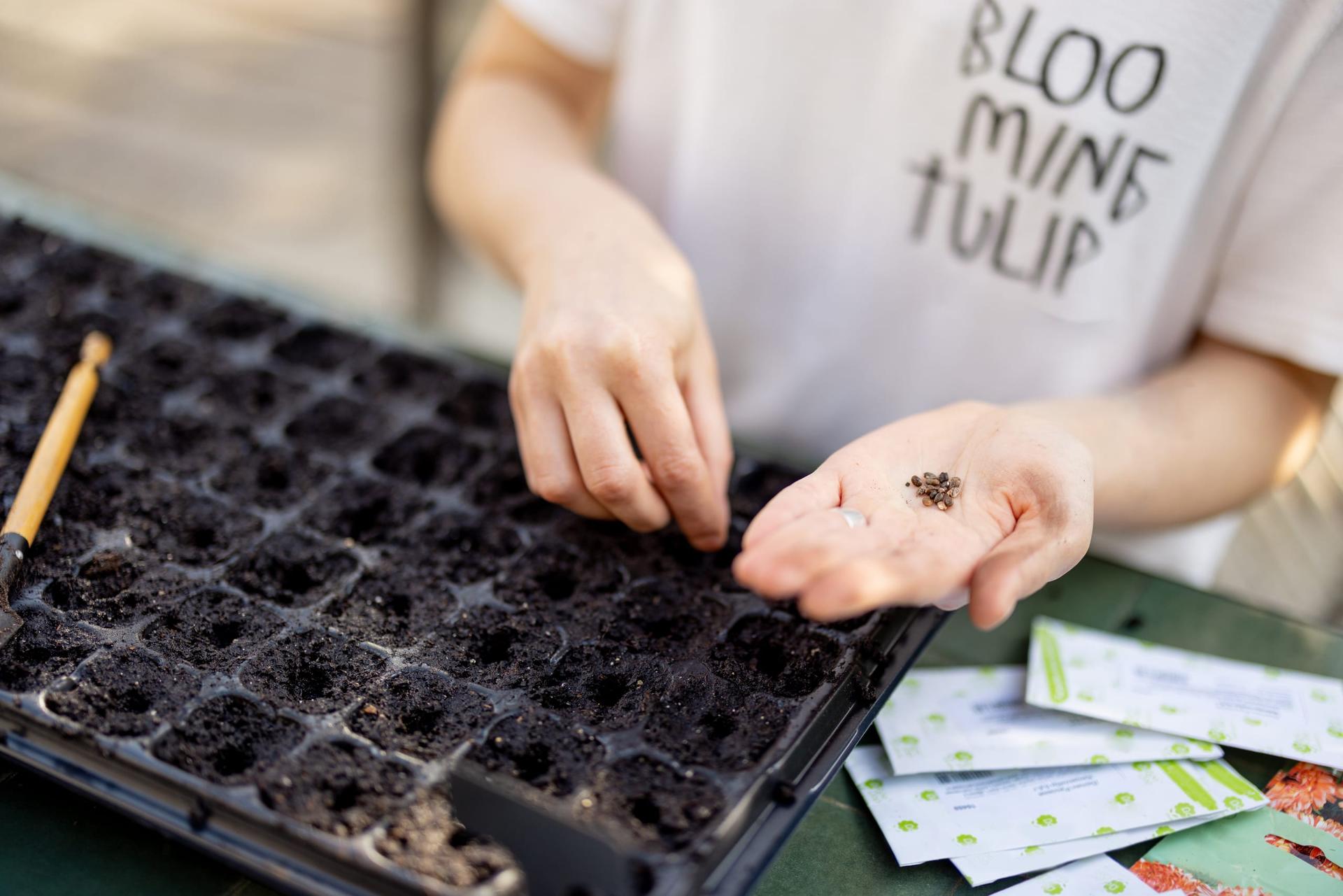
Indoors, count backwards from your last frost. The seed packet gives the head start each plant needs. The Toronto Master Gardeners put parsley at "about eight weeks before the last frost" ("in colder climates like ours"), lemon balm at six weeks, and French sorrel at three. Take parsley's eight weeks, which is 56 days, and subtract:
- Downtown: April 11 - 56 days = February 14
- Pearson: April 27 - 56 days = March 2
- Buttonville: May 3 - 56 days = March 8
Same seed, same instruction, twenty-two days apart across one region.
Outdoors, count forwards. The Toronto Master Gardeners' urban vegetable guide gives direct-seeding dates for Toronto in four bands. Direct seeding means putting the seed straight into the garden soil. Frost hardy (lettuce, peas, radishes, spinach): April 15-25. Semi-frost hardy (beets, carrots): April 25-May 10. Semi-frost tender (snap beans, tomato transplants): May 15-25. Frost tender (transplanted cucumbers, peppers, squash): May 25-June 5. Those are Toronto dates. If your station's last frost is later than downtown's, shift the whole set later by the same margin: about two weeks at Pearson, about three at Buttonville.
At the end of the season, count backwards from the first frost. The packet also gives days to maturity, the time from sowing to harvest. Take that off your station's first-frost date to get the last useful sowing day. At Buttonville, October 13 - 60 days lands on August 14. At the downtown station, November 6 - 60 days gives September 7. That is twenty-four extra days of sowing, from the same seed packet.
Two conditions travel with all of it. First, seedlings raised indoors have to be hardened off, which means getting them used to outdoor air a little at a time. The Toronto Master Gardeners describe a process "over about ten days to two weeks," starting with "two or three hours a day" in a shaded, protected spot. Second, their guide says you can plant earlier than these dates "if you will be around to cover your plants if there is a cold snap, and if your garden is small enough that you can cover the plants."
The month-by-month calendar
Dates are keyed to Toronto Pearson, the middle of the three stations. Shift about two weeks earlier downtown and about a week later in Markham. Newmarket, Uxbridge and Georgina have no station of their own. Their hardiness indices sit below Markham's, so treat them as later again rather than borrowing Markham's dates.
Month | Start indoors | Sow or plant outdoors | Why |
|---|---|---|---|
January | Cold-stratify seeds that need it | Nothing | "Two weeks to five months" of moist cold |
February | Slowest starters, downtown only | Nothing | 8 weeks before Apr 11 = Feb 14 |
March | Parsley, peppers, other six-to-eight-week seedlings | Nothing | 8 weeks before Apr 27 = Mar 2 |
April | Faster seedlings; harden off from late month | Lettuce, peas, radishes, spinach from Apr 15 | Frost-hardy, so they precede last frost |
May | Last indoor sowings | Beets and carrots to May 10; snap beans and tomato transplants May 15-25; cucumber, pepper, squash transplants from May 25 | Pearson's 10% frost date is May 19 |
June | – | Finish warm-season planting; second sowing of beans | Soil has actually warmed |
July | – | Successional beans, zucchini, fast greens | Must still mature before first frost |
August | – | Autumn greens; second lettuce sowing late month | Oct 20 - 60 days = Aug 21 for a 60-day crop |
September | – | Begin bulbs; re-seed the lawn early in the month | "Re-seeding is best done in early September" |
October | – | Narcissus, allium, small bulbs by early October; garlic | Cloves need roots before freeze-up |
November | – | Tulips while the ground can be worked; fertilise the lawn in week one | Mulch perennials only once frozen |
December | – | Nothing | Frozen ground; plan next year's beds |
Three autumn deadlines worth treating as real
Garlic. Ontario's garlic production factsheet says garlic here "is grown as a winter annual - planted in the fall and harvested the following summer." It adds that "it is critical that garlic not be planted too early or too late." Both mistakes are named. Plant too early or too shallow, and "there is a risk that shoots will emerge above the soil surface and be prone to winter injury." Plant too late, and "cloves will not develop adequate root systems and will not be winter hardy." For mulch, the factsheet names straw as the most common choice, "applied 10-15 cm deep directly over the planted garlic rows."
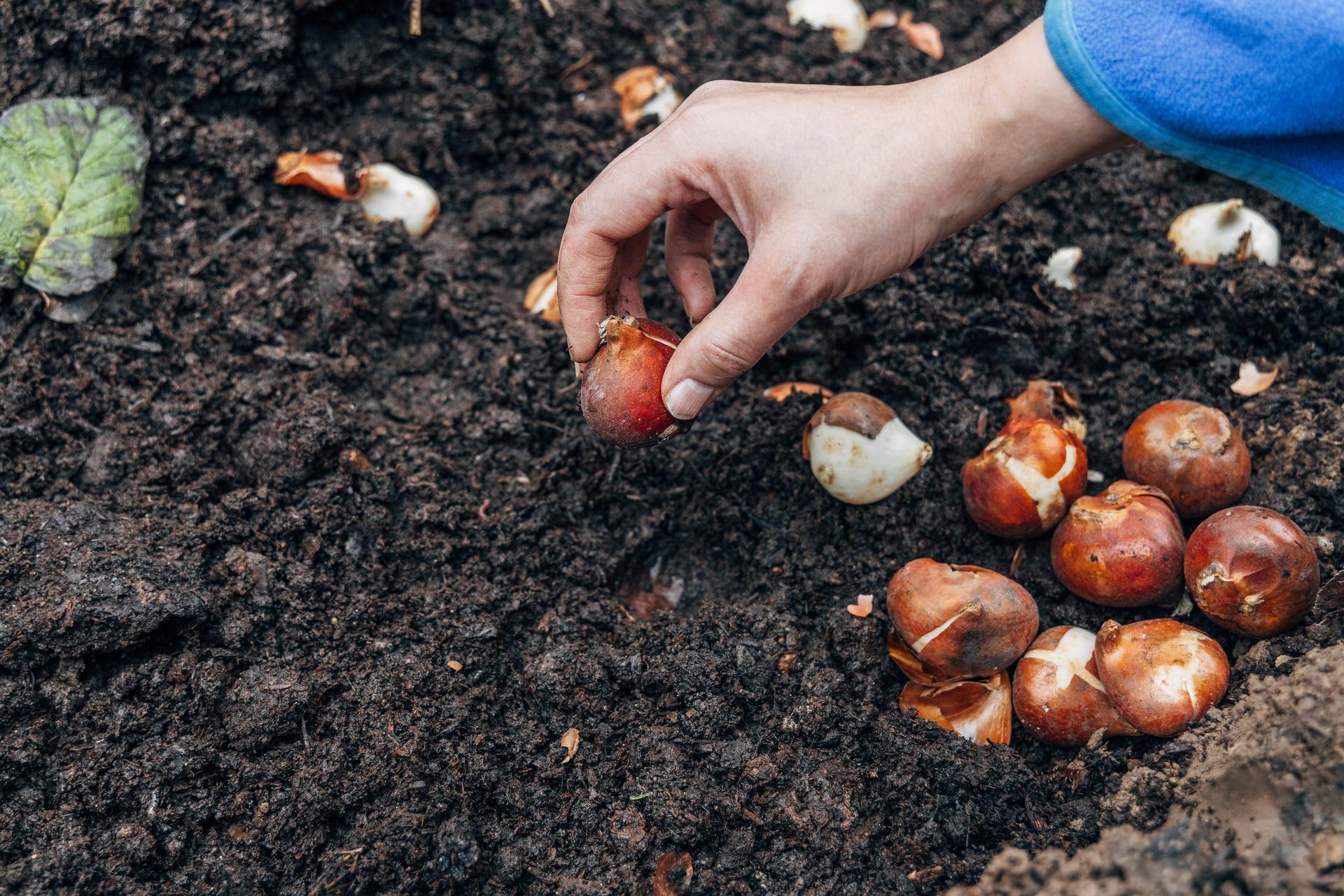
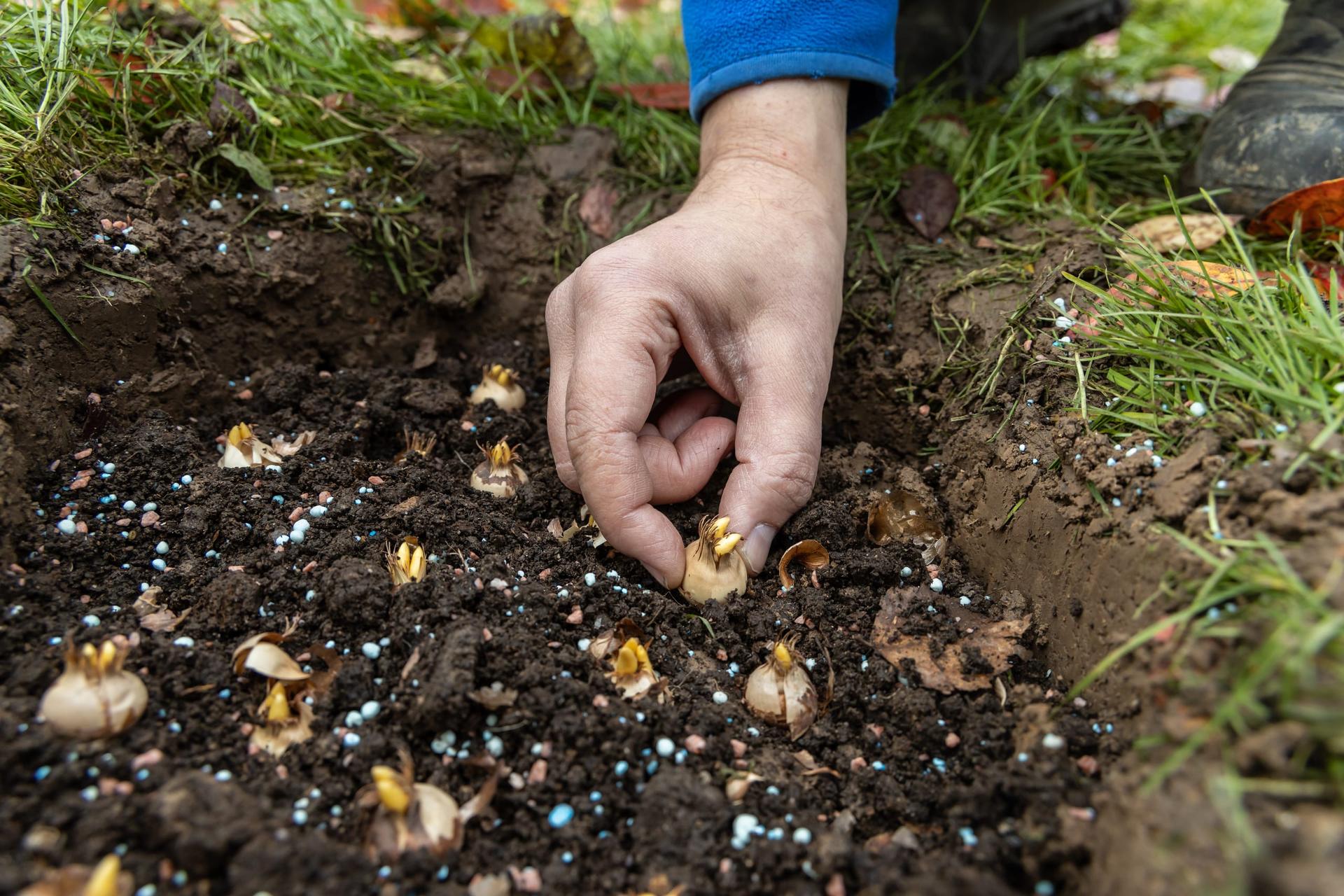
Bulbs. The Toronto Master Gardeners' autumn guide says to "begin planting bulbs in September," with narcissus, allium and small bulbs "planted by the end of September or early October." Tulips are the exception: they "can be planted as long as the ground can still be worked before freeze-up."
Lawn and mulch. The same guide puts lawn re-seeding in early September, because "after September the lawn needs a slow growth period to harden off for winter". Miss that window and its advice is to "wait for spring" rather than seed late. It names the first week of November as the best time in Toronto to feed a lawn. The mulch instruction carries a condition people often drop. Mulch tender perennials after the ground has frozen, because "mulch is not used to keep the plants warm but to keep them frozen in the spring sunshine, by minimizing the damage caused by heaving of the soil."
What Ontario's own planting dates say, and what they don't
The province does publish firm planting dates, but for a purpose that is not yours. Appendix 2 of Ontario's AgriInsurance operational document sets the earliest and latest planting dates that commercial production insurance will cover. That is not the same thing as what a gardener should do. Read with that condition attached, it is still the only official Ontario date list of its kind.
Two conditions govern every figure in it. First, the tables split by the type of insurance. Crops "insured based on yield" carry one planting deadline. Crops "insured on an acreage loss basis" carry earliest and latest dates in three crop-heat-unit classes, which sort areas by how much summer warmth they get: 2500-2700, 2700-3100 and over 3100. Sweet corn appears in both, at 5 July under the yield-based table and 25 June in the 2700-3100 acreage-loss class. That is not a contradiction. They are two different products, and quoting either one as "Ontario's sweet corn deadline" would be wrong.
Second, and this is the limit that matters most here: the appendix never says which heat-unit class any Ontario municipality falls in. We searched the whole document for York, Peel, Durham, Halton, Toronto, Simcoe, "county", "region" and "municipal". It returns four matches, all footnotes: green peas and beets in Essex and Kent County, and garlic's coverage period. It does publish a "Map of planning deadline defined areas" and it does name regions in its footnotes. But those define Areas A to E for the grain, oilseed and fruit tables. No municipality is ever given a crop-heat-unit class, and that is the one thing a GTA gardener needs. So compare the columns. Do not assume which one covers you.
With those conditions carried, the useful figure is garlic's. Its latest insurable planting date runs 1 November in the 2500-2700 class, 5 November in 2700-3100 and 10 November above 3100. That is a spread of nine days across the whole province, which is why "plant garlic in the first week of November" survives as ordinary advice.
Look up your own station before you plant
The 47-day gap between the downtown and Markham frost-free periods is wider than the margin most planting advice allows for. And because the downtown record is the shorter one, the true gap is probably a little smaller. Pull the Environment and Climate Change Canada normals for the station nearest you. Note the record length beside the dates, then build this calendar again from your own two dates.
Frequently asked questions
What hardiness zone is Toronto in?
Zone 7a on Canada's current 1991-2020 map, with a hardiness index of 71. Toronto was 6a on the 1961-1990 map, which is why older books say 5b or 6a.
Can I use a USDA zone chart for my Toronto garden?
Not reliably. The USDA system sorts places by average annual low temperature alone. Canada's uses seven climate measures. Natural Resources Canada found there are "no simple conversions between the two systems," and that Canadian zone 4a overlaps nine different USDA zones, from 3a to 7a.
When is the last frost in the GTA?
It depends which part. The 1991-2020 averages are April 11 downtown, April 27 at Pearson and May 3 at Buttonville in Markham. Averages are not safe dates. At Pearson there is still a 10% chance of frost on or after May 19.
Is it too late to plant garlic in November?
Usually not, but you are near the edge. Ontario's latest insurable garlic planting date is 1 November in the 2500-2700 heat-unit class, 5 November in 2700-3100 and 10 November above 3100. Those are commercial insurance limits, not gardening ones. The province's factsheet warns that cloves planted too late "will not develop adequate root systems and will not be winter hardy."
Sources (14)
- Plant Hardiness Zone by Municipality · Natural Resources Canada, Canada's Plant Hardiness Site (retrieved )
- Climate Variables used to develop Canada's Plant Hardiness Zones · Natural Resources Canada, Canada's Plant Hardiness Site (retrieved )
- Extreme Minimum Temperature Models · Natural Resources Canada, Canada's Plant Hardiness Site (retrieved )
- Canadian Climate Normals 1991-2020: Toronto (City), climate ID 6158355 · Environment and Climate Change Canada (retrieved )
- Canadian Climate Normals 1991-2020: Toronto Lester B. Pearson Int'l A, climate ID 6158733 · Environment and Climate Change Canada (retrieved )
- Canadian Climate Normals 1991-2020: Toronto Buttonville (Airport), climate ID 6158409 · Environment and Climate Change Canada (retrieved )
- Appendix 2: Seeding and harvesting deadlines · Ontario Ministry of Agriculture, Food and Agribusiness (retrieved )
- Garlic production · Ontario Ministry of Agriculture, Food and Agribusiness (retrieved )
- Growing Urban Vegetables: A Toronto Master Gardeners Guide · Toronto Master Gardeners (retrieved )
- Putting the Garden to Bed: A Toronto Master Gardeners Guide · Toronto Master Gardeners (retrieved )
- How to Grow Parsley: A Toronto Master Gardeners Guide · Toronto Master Gardeners (retrieved )
- How to Grow Lemon Balm: A Toronto Master Gardeners Guide · Toronto Master Gardeners (retrieved )
- How to Grow French Sorrel: A Toronto Master Gardeners Guide · Toronto Master Gardeners (retrieved )
- Growing from Seed: A Toronto Master Gardener Guide · Toronto Master Gardeners (retrieved )
How this guide was made
Built on 26 August 2026 from two primary datasets. Natural Resources Canada's Plant Hardiness Zone by Municipality lookup returns one municipality at a time, so it was queried separately for 25 GTA and neighbouring towns and the results compiled into the regional table below, each row classified by whether its zone changed between the 1961-1990 and 1991-2020 maps. Frost dates and their probability distributions come from Environment and Climate Change Canada's 1991-2020 Canadian Climate Normals for three GTA stations (Toronto City, Toronto Pearson, Toronto Buttonville), including each station's record length and missing-year counts. Planting windows come from Ontario's AgriInsurance seeding-deadline appendix, the province's garlic production factsheet, and six Toronto Master Gardeners guides. Every date was read from the source page; no US planting chart was used.