Key takeaways
- The Eco-Roof Incentive Program pays $100 per square metre of vegetated area installed, to a maximum of $100,000 per green roof project, and the application must be approved before any work starts.
- A separate Structural Assessment Grant pays the cost of an engineer's load report or $1,000.00, whichever is less, and you keep it even if the engineer rules the building out.
- As of November 3, 2025 the City says the Green Roof Bylaw is no longer applicable law under the Ontario Building Code, so it no longer requires a green roof on any building.
- A building permit is still required for every new green roof, priced at $6.20 per square metre of work with a minimum fee of $214.79 in 2026.
- Three companies serving the GTA publish green roof figures running from $10 to $40 per square foot, and none of the three says whether HST is included.
Toronto pays $100 for every square metre of vegetated area you install on a roof, up to $100,000 per green roof project. It also pays up to $1,000.00 for the engineer's report that says whether an existing building can carry one. You still need a building permit, and your drawings are still checked against the City's green roof construction standard. What ended is the rule that forced some buildings to have one. The City's own permit guide dates that change. As of November 3, 2025 the Green Roof Bylaw "is no longer applicable law under the Ontario Building Code", and applicants "are encouraged to provide Green Roofs on a voluntary basis".
What a green roof actually is
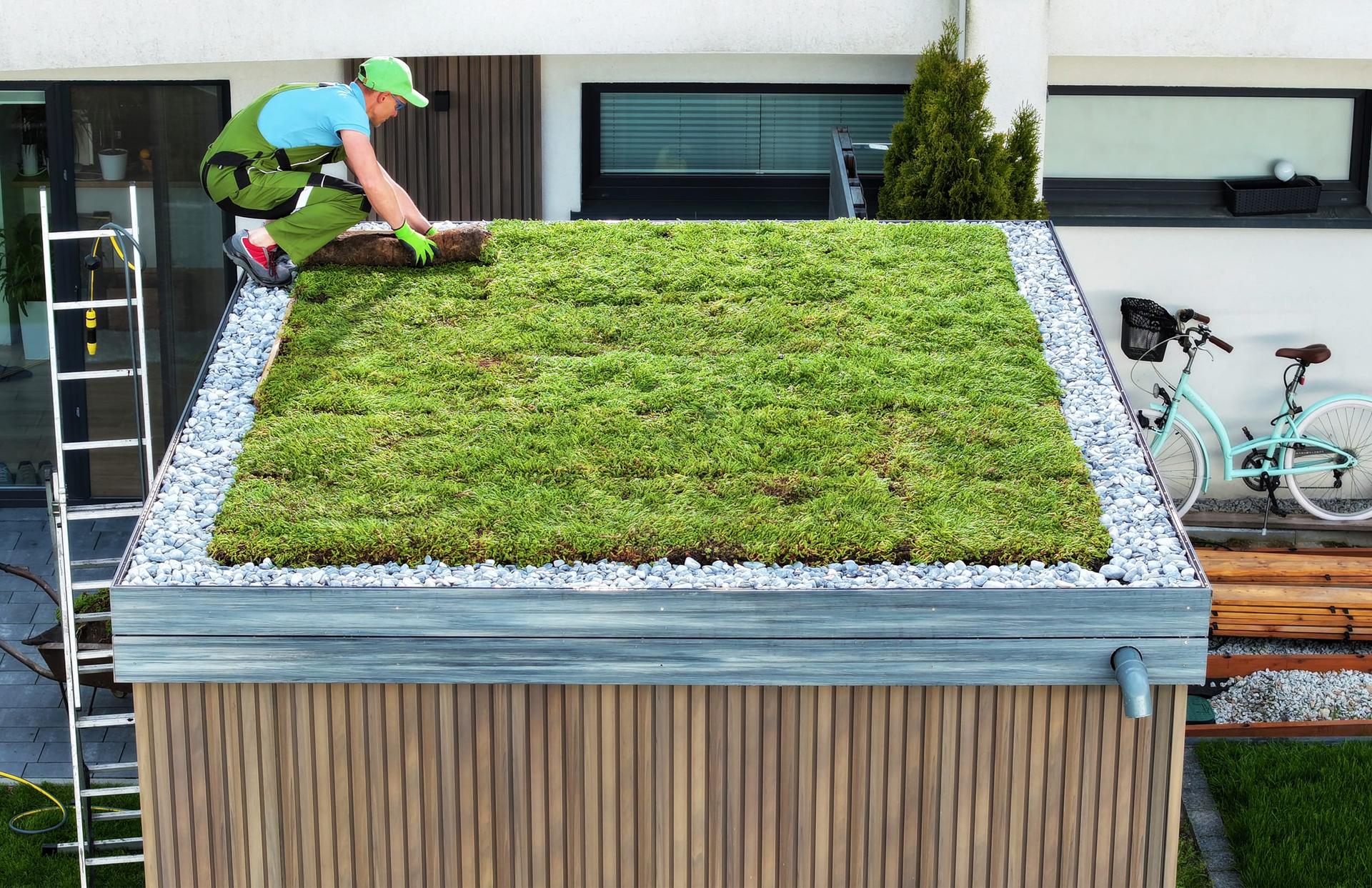
A green roof is a living layer built on top of a real roof. Chapter 492 defines one as an extension of an above grade roof that allows vegetation to grow in a growing medium, which is soil. It has to be built to the Toronto Green Roof Construction Standard.
The bylaw sets the minimum layers. Section 492-9 A requires a root repellent system, a drainage system, a filtering layer, a growing medium and plants, all installed on a waterproof membrane. Pots do not count. The City states it plainly: "planter boxes on rooftops do not meet the definition of a green roof as they are not an extension of the roofing system".
The City sorts green roofs into three kinds. They differ mostly in how deep the soil is.
| Type | Growing medium | Plants the City names | What the City says about weight, upkeep and cost |
|---|---|---|---|
| Extensive | Shallow | Mosses and succulents | Lighter, less structural support, less frequent maintenance, lower cost |
| Semi-intensive | Deeper substrate | Grasses, herbaceous perennials, shrubs | More weight, more maintenance and higher cost than extensive |
| Intensive | Deep | Perennials, bushes and trees | Installation and maintenance costs higher than extensive or semi-intensive |
Can your house take one?
Weight decides it. The construction standard sets a floor of 100 millimetres of growing medium where the structure allows. It lets the designer assume a saturated soil density of 2,000 kilograms per cubic metre. Multiply those two numbers: 0.1 x 2,000 = 200 kilograms per square metre of wet soil alone, before plants, the drainage layer and the water retention mat. A house roof framed for shingles may not have been designed to carry that.
Slope is the next test. Any roof steeper than 10 degrees, which the bylaw also writes as 17 per cent, has to include anti-shear measures so the soil cannot slide off.
Then the roof underneath. The standard requires a root barrier in every vegetated system. Immediately before the green roof goes on, you have to run one of seven leakage tests. The list is a flood test, electric field vector mapping, an impedance test, infrared thermal imaging, low voltage testing, high voltage testing, or moisture sensors. An architect or engineer signs the report for the inspector. Toronto Building also asks for a wind uplift report from a professional engineer with the permit application.
That is not a homeowner's call, which is why the City pays for the engineer.
The City covers up to $1,000 of the structural check
The Structural Assessment Grant pays for the report that tells you whether your building can hold a green roof. It is worth the actual cost of the assessment or $1,000.00, whichever is less. It is for existing buildings only, and you must hire a structural engineer licensed to work in Ontario. The report has to look at the weight of the green roof only, not decking, a pool or furniture.
If the engineer finds the building cannot carry the load, you do not have to build anything and you still get the grant. The terms name only two ways the money is paid: as part of a completed green roof, or where the report says the building cannot take one. They do not say what happens if the report is positive and you decide not to build.
What the Eco-Roof Incentive Program pays
$100 per square metre of vegetated area installed, to a maximum of $100,000 per green roof project. The same program also funds cool roofs, which reflect sunlight instead of growing plants. Those pay $5 per square metre with a new membrane, or $2 for a coating over an existing roof, capped at $50,000.
The City lists three eligible groups for the green roof grant:
- Existing residential, industrial, commercial and institutional buildings.
- New residential, industrial, commercial and institutional buildings with a gross floor area of less than 2,000 m².
- All new construction projects by Toronto School Boards and not-for-profit organizations.
The terms add that the roof must be above grade: parking garages and at-grade roofs are not eligible.
Two conditions catch people out. The first is coverage. To qualify, a building under 4,999 m² of gross floor area must green at least 20 per cent of its available roof space. Available roof space is the total roof area minus three things: renewable energy areas, private terraces and residential outdoor amenity space. That last one is capped at 2 square metres per unit. The second is timing. Your application has to be approved before any work starts, and the City warns that projects already started or finished "may not be eligible for funding".
You need the building permit first. The application asks for your permit number, and the City will not release the money until that permit is closed.
After that it runs to a schedule. The terms promise a funding decision within six weeks of applying. You then have one year from the approval date to finish, with one additional year available on request. One line is easy to miss. Section 4 of the terms asks that the project be scheduled for completion within six months of the funding notice. Section 9 gives you the year. Payment goes to the registered property owner by direct deposit, after a site visit.
Check the rate against the City, not your roofer
Avenue Road Roofing is a Toronto roofer. As of August 28, 2026, its page still describes the Eco-Roof grant as "$75.00 per square metre of roof surface, up to a maximum of $100,000.00". Two things there are out of date: the rate is now $100 per square metre, and it is paid on vegetated area installed, not on roof surface. On a 40 m² green roof that is the difference between 40 x $75 = $3,000 and 40 x $100 = $4,000.
What a green roof costs to build
Three companies serving the GTA publish a green roof figure on their own sites.
| Item | Low | High | Unit |
|---|---|---|---|
| Small extensive green roof (Great Northern Insulation) | $10 | $20 | per sq ft, as published |
| Intensive green roof (Great Northern Insulation) | $20 | $40 | per sq ft, as published |
| Extensive green roof in Toronto (NLSM, green roof supplier) | $25 | $35 | per sq ft, as published |
| Green roof, replacing an existing roof (D'Angelo & Sons) | $12 | $18 | per sq ft, as published |
| Same job, total for a 1,500 sq ft roof (D'Angelo & Sons) | $18,000 | $27,000 | total, 1,500 sq ft |
Across the four rows priced per square foot, the published figures run from $10 to $40. That is the span of what three companies advertise, not a market average: they are not pricing the same thing. Great Northern Insulation is the only one that splits its figure by type. D'Angelo & Sons prices a green roof as a roof replacement and calls it intensive. NLSM publishes one figure, for a typical Toronto extensive roof. None of the three pages says whether HST is in the number, and only D'Angelo & Sons dates its figures.
The grant covers a fixed slice of that. Divide $100 by the 10.7639 square feet in a square metre and the City is paying $9.29 per square foot. Against D'Angelo & Sons' low end of $12.00 that is most of the job. Against the $40 top of the range it is under a quarter.
The permit, and the minimum that catches small roofs
Chapter 492 requires a permit for a new green roof, even where nobody is making you build it. Toronto Building's permit guide adds the material alteration of an existing green roof. Where the green roof is part of a new building or an addition, there is no extra fee. On its own, it is charged at the rate for "Re-roofing with structural work, raise roof structure", which is $6.20 per square metre in 2026. The guide lists a second rate in the same table: $0.76 per square metre for non-structural re-roofing. Chapter 492, section 492-7 B points a green roof application at the structural classification, which is the $6.20 line, so that is the rate used below.
That rate rarely bites on its own, because the City charges a minimum fee of $214.79 for all work in 2026. Divide $214.79 by $6.20 and the two meet at about 34.6 square metres. Below that, you pay the minimum.
| Green roof area | Fee at $6.20/m² (CAD) | Permit fee charged (CAD) | Eco-Roof grant at $100/m² (CAD) |
|---|---|---|---|
| 20 m² | 124.00 | 214.79 (minimum) | 2,000 |
| 30 m² | 186.00 | 214.79 (minimum) | 3,000 |
| 40 m² | 248.00 | 248.00 | 4,000 |
| 60 m² | 372.00 | 372.00 | 6,000 |
| 100 m² | 620.00 | 620.00 | 10,000 |
| 200 m² | 1,240.00 | 1,240.00 | 20,000 |
A 20 m² roof works out at 20 x $6.20 = $124.00, so the $214.79 minimum applies instead. On a 100 m² roof the permit is 100 x $6.20 = $620.00 against a grant of 100 x $100 = $10,000, about six per cent of what the City hands back.
What you promise when you take the money
Chapter 492 requires a maintenance plan, and it has to be filed with the permit application, not written later. The plan must set out routine maintenance and inspection for the roof's design service life. It has to cover the growing medium, the plants, and replanting if that ever becomes necessary.
The City wants specifics in it. Name how vegetated areas are protected from foot traffic, and the amount, timing and control of irrigation. Give the amount, type and timing of fertilizer. Cover weed management, including which weeds and how often, replanting, and periodic inspection of drains, edging, roof penetrations and flashings.
There is a planting target behind that. Within three years of the planting date, the plants must cover no less than 80 per cent of the vegetated roof. The plan also has to get complete coverage at canopy level within three growing seasons and hold it for the roof's service life.
Then there is money at risk. The program's terms let the City inspect a green roof during its life and claw back part of the grant if it has not been kept up. Its own worked example: say $20,000 was paid for a green roof meant to last 20 years, and in year 15 it does not function at all. The owner repays $5,000, the 25 per cent of the lifespan that was lost. Removing the roof is a separate rule. You must give the City 60 days' notice first and repay the grant at the current rate.
What the bylaw required, and what changed
Before November 2025 the rule was about size, not house type. Chapter 492 applied to buildings and additions built after January 30, 2010 with a gross floor area of 2,000 square metres or more. Coverage rose with the building.
| Gross floor area | Green roof coverage of available roof space |
|---|---|
| 2,000 to 4,999 m² | 20 per cent |
| 5,000 to 9,999 m² | 30 per cent |
| 10,000 to 14,999 m² | 40 per cent |
| 15,000 to 19,999 m² | 50 per cent |
| 20,000 m² or greater | 60 per cent |
Ordinary houses were never in scope. Section 492-5 B exempted any residential building no taller than the greater of six storeys or 20 metres. A developer who could not meet the coverage could ask the Chief Planner for an exemption. The price was cash in lieu. Section 492-12 A deemed it $200.00 per square metre of the area not built, and the City's bylaw page still publishes that figure. The money went straight back into the Eco-Roof Incentive Program.
What changed is the Province, and not by passing a new law. Chapter 492 was passed under section 108 of the City of Toronto Act, 2006. That section always carried its own end date. Subsection 108(4) of the Act as enacted says the section "is repealed on a day to be named by proclamation of the Lieutenant Governor", and the Province named November 3, 2025. The e-Laws consolidation now shows section 108 repealed by that subsection. Without that power, the City says the bylaw stopped being applicable law under the Ontario Building Code on the same date.
The Green Roof Declaration Form dropped out of the permit package. The City's own bylaw page now opens in the past tense: from 2010 to 2025 the bylaw supported a $50-million industry and helped install more than 1,200 green roofs.
But toronto.ca has not caught up with itself. That same page, last modified November 12, 2025, still sets out the coverage chart and the $200.00 cash in lieu in the present tense. It also still tells applicants that a permit application for a green roof, required or voluntary, "must complete the the Green Roof Declaration Form". The doubled word is the City's. The permit guide is the newer page, modified February 12, 2026, and it is the one Toronto Building sends permit applicants to.
Plenty survived. The City still applies a 50 per cent green roof standard to new buildings put up by itself and its agencies, boards and commissions. The construction standard is still the rulebook a voluntary roof is measured against. Toronto Building's permit guide, last modified February 12, 2026, says staff check plans against it, and the Eco-Roof program makes it a condition of the money.
Frequently asked questions
Do I need a permit to install a green roof in Toronto?
Yes. Toronto Building's guide says a permit is required for a new green roof, and for materially altering an existing one. Chapter 492, section 492-4 D says the same for a green roof nobody is making you build. The Eco-Roof grant is not paid until that permit is closed.
How much does it cost to install a green roof?
Three companies serving the GTA publish a figure, running from $10 to $40 per square foot. D'Angelo & Sons puts a green roof replacement at $12.00 to $18.00 per square foot, or $18,000 to $27,000 for a 1,500 sq ft roof. None of the three states whether HST is included.
What are the requirements for a green roof in Toronto?
Toronto Building's permit guide, modified February 12, 2026, says staff check plans against the Toronto Green Roof Construction Standard in Article IV of Chapter 492. The standard covers the full assembly on a waterproof membrane, a gravity load calculation and anti-shear measures above 10 degrees of slope. It also takes an engineer's wind uplift report, a leakage test before installation, and a maintenance plan filed with the permit. Chapter 492 adds a vegetation-free border beside combustible roof features, as wide as the plants are tall at maturity and never less than 0.5 metres. After installation you file a Green Roof Inspection Report Checklist and a backflow prevention device test report.
What is the green roof bylaw?
It is Toronto Municipal Code Chapter 492, adopted by Council in 2009. It required green roofs on new buildings of 2,000 square metres or more, and it set the construction standard for every green roof in the city. As of November 3, 2025 the City says it is no longer applicable law under the Ontario Building Code, so the Green Roof Bylaw no longer requires a green roof on any building.
How long will a green roof last?
The bylaw and the grant both work from whatever service life your own design and maintenance plan states. D'Angelo & Sons puts a green roof at 30 to 50 years in its 2026 Ontario price table, against 15 to 25 years for a plain flat roof. The Eco-Roof terms use a 20-year roof in their repayment example.
Can I put a green roof on my shed?
Every new green roof in Toronto needs a building permit, whatever it sits on, and it has to meet the construction standard. The grant covers existing residential, industrial, commercial and institutional buildings, new ones under 2,000 m² of gross floor area, and school board or not-for-profit projects. The roof must be above grade, so parking garages and at-grade roofs are out. Program staff take questions at ecoroof@toronto.ca.
What are the downsides of using green roofs?
Weight is the first: 100 millimetres of saturated growing medium alone works out at 0.1 x 2,000 = 200 kilograms per square metre. Price is the second. In D'Angelo & Sons' own table a green roof is $12.00 to $18.00 per square foot against $4.00 to $6.00 for a plain flat roof. Third, maintenance is a commitment, and the City can claw back part of the grant if the roof stops working early.
Sources (13)
- Toronto Municipal Code Chapter 492, Green Roofs (consolidation dated November 9, 2017) · City of Toronto (retrieved )
- Eco-Roof Incentive Program · City of Toronto (retrieved )
- Eco-Roof Incentive Program Terms and Conditions (2025 update) · City of Toronto (retrieved )
- Green Roof on a New or Existing Building (building permit guide, modified February 12, 2026) · City of Toronto (retrieved )
- Building Permit Fees (fees effective January 1, 2026) · City of Toronto (retrieved )
- City of Toronto Green Roof Bylaw (modified November 12, 2025) · City of Toronto (retrieved )
- Green Roof Overview · City of Toronto (retrieved )
- City of Toronto Act, 2006, S.O. 2006, c. 11, Sched. A (e-Laws consolidation period June 2, 2026, currency date August 25, 2026) · King's Printer for Ontario (retrieved )
- City of Toronto Act, 2006, S.O. 2006, c. 11, Sched. A, as enacted (section 108, construction of green roofs) · King's Printer for Ontario (retrieved )
- Green Roof Design · Great Northern Insulation (retrieved )
- 2026 Ontario Roof Replacement Costs: Roof Type and Prices · D'Angelo & Sons (retrieved )
- Case Studies · NLSM (retrieved )
- Green Roof Grants · Avenue Road Roofing (retrieved )
How this guide was made
Checked on August 27 and 28, 2026. Every rule, rate and fee was read from the City of Toronto itself: Municipal Code Chapter 492, the Eco-Roof Incentive Program page, the program's 2025 Terms and Conditions PDF, the Green Roof Bylaw page, the Green Roof Overview page, the Toronto Building permit guide for green roofs, and the 2026 building permit fee schedule. The repeal was confirmed in the e-Laws consolidation of the City of Toronto Act, 2006 and in that Act as enacted. Prices come from three companies serving the GTA that publish a green roof figure on their own sites, each raw page checked for struck-out numbers. The permit-fee table applies the City's own fee formula and minimum to green roof areas the City does not price itself.